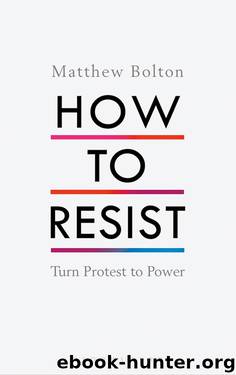
How to Resist by Matthew Bolton
Author:Matthew Bolton
Language: eng
Format: epub
ISBN: 9781408892732
Publisher: Bloomsbury Publishing
Published: 2017-06-23T10:41:47+00:00
The example from history of ‘the action is in the provocation of an overreaction’ that has inspired me the most took place in Selma in 1964–65. The account that follows is a simplified version of a more complex reality.
Despite the 1964 Civil Rights Act, which in theory ended discrimination on the basis of race and would enable African Americans to vote, in many areas this had made little difference to actual voting numbers due to various bureaucratic barriers, plus outright intimidation. Martin Luther King Jr and key leaders from the Southern Christian Leadership Conference and the Student Nonviolent Coordinating Committee were working on a strategy to win a much stronger Act and were looking for a place to make the focal point of the campaign. They selected Selma in Dallas County, where only 300 out of a possible 15,000 African Americans had managed to register to vote. The Governor of Alabama, George C. Wallace, was steadfastly pro-segregation and the local Dallas County sheriff, Jim Clark, had a reputation for violent conduct towards African Americans. It wasn’t the fact that Selma was a place where the problem was at its worst that made the civil rights campaigners pick it. It was the fact that Selma was a place where they thought they could prompt an overreaction from the authorities and enable an escalation of the campaign that might create the energy and urgency to move the president, Lyndon B. Johnson.
Through January and February 1965, there were small protests and marches. On 26 February an Alabama state trooper shot and killed a young African-American demonstrator, Jimmie Lee Jackson – the first, tragic overreaction from the local police. A march from Selma to the state capital of Montgomery took place in response to this killing on 7 March. Under the policing of Sheriff Clark and Governor Wallace, a peaceful march of 600 men, women and children became violent, as protestors were brutally attacked by troopers wielding whips and nightsticks and firing tear gas. The scenes were broadcast on television and this grotesque overreaction by the authorities brought in further activists, civil rights leaders and religious leaders of all faiths in their thousands to Selma. A further protest planned for 9 March was halted early by Martin Luther King Jr and other leaders in the face of another likely brutal response by the police. Civil rights leaders and supporters called for federal action on protection for the Selma marchers and also for a new Act to guarantee voting rights. As tension rose, there was another killing by segregationists – this time the victim was a young white minister, James Reeb.
The local struggle became national news and impossible to ignore. President Johnson intervened to guarantee the safety of those marching and on 21 March, 25,000 people, under the protection of 1,900 National Guard, marched from Selma to Montgomery. Public opinion had been changed and by August 1965 the new Voting Rights Act was passed, prohibiting racial discrimination and lifting many of the barriers that prevented equal access to the vote.
Download
This site does not store any files on its server. We only index and link to content provided by other sites. Please contact the content providers to delete copyright contents if any and email us, we'll remove relevant links or contents immediately.
| Anthropology | Archaeology |
| Philosophy | Politics & Government |
| Social Sciences | Sociology |
| Women's Studies |
The Secret History by Donna Tartt(19097)
The Social Justice Warrior Handbook by Lisa De Pasquale(12193)
Thirteen Reasons Why by Jay Asher(8915)
This Is How You Lose Her by Junot Diaz(6891)
Weapons of Math Destruction by Cathy O'Neil(6283)
Zero to One by Peter Thiel(5805)
Beartown by Fredrik Backman(5763)
The Myth of the Strong Leader by Archie Brown(5511)
The Fire Next Time by James Baldwin(5452)
How Democracies Die by Steven Levitsky & Daniel Ziblatt(5221)
Promise Me, Dad by Joe Biden(5155)
Stone's Rules by Roger Stone(5089)
A Higher Loyalty: Truth, Lies, and Leadership by James Comey(4965)
100 Deadly Skills by Clint Emerson(4929)
Rise and Kill First by Ronen Bergman(4792)
Secrecy World by Jake Bernstein(4755)
The David Icke Guide to the Global Conspiracy (and how to end it) by David Icke(4721)
The Farm by Tom Rob Smith(4516)
The Doomsday Machine by Daniel Ellsberg(4492)
